
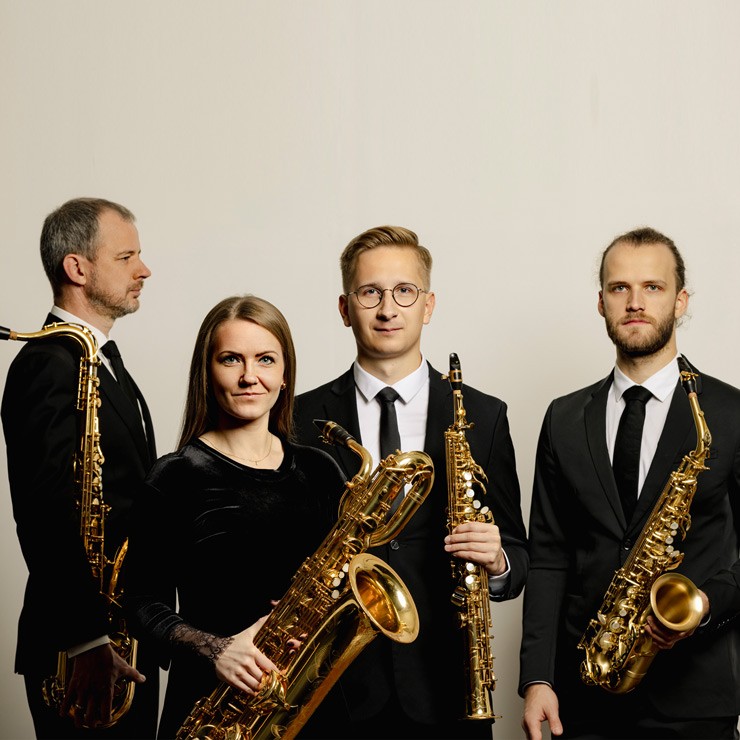
Kārlis Lācis, Philip Glass, and the Riga Saxophone Quartet
Participants
Terēze Gretere, soprano
Rūdolfs Pēteris Rubenis, saxophone
Aigars Raumanis, saxophone
Ainars Šablovskis, saxophone
Baiba Tilhena, saxophone
Programme
Georgs Pelēcis / lyrics by Alfrēds Krūklis Cantata In The Snow Cradle (Sniega šūpulī) for soprano and saxophone quartet (2010)
I. “I want to go to the horizon” (Tā gribas vēl aiziet līdz apvārsnim)
II. “White peace” (Balts miers)
III. “It is Christmas Eve” (Ir Ziemassvētku vakars)
IV. “Interlude” (Interlūdija)
V. “Snow” (Sniegs)
VI. “Sleep, my child, sleep” (Dusi, mans bērniņ, dusi)
Philip Glass Saxophone Quartet (1995)
Kārlis Lācis / poetry by Imants Ziedonis / arrangement by Aigars Raumanis Songs from the album Ziedonis. Lācis. Sievietes: “There Are People Like That” (Ir tādi cilvēki), “You Came to Me for the Second Time” (Tu atnāci pie manis nu jau otrām lādzēm), “Don’t Live Without Love” (Bez mīlestības nedzīvojiet), “Nothing. Nothing” (Nieki. Nekas), “Nothing is Lacking” (Nekā jau nepietrūkst).
The repertoire of the Riga Saxophone Quartet is diverse in style and genre, and the geographical scope of the quartet’s concerts is equally impressive. Over the course of more than thirty years, this experienced ensemble has collaborated with many outstanding artists. The programme “Tu atnāci pie manis” (You Came to Me) marks the quartet’s first creative encounter with the young singer Terēze Gretere, jointly revisiting compositions by Georgs Pelēcis and Kārlis Lācis. The genetic predecessors of Pēlecis’ sound art can be found in Renaissance and Baroque music, as well as in minimalist aesthetics. The most accurate description of his musical style seems to be “new consonant music,” where euphony is the ideal of harmony. In his 2010 cantata “Sniega šūpulī” (In the Snow Cradle), he has set Alfrēds Krūklis’ evocative verses to music. Like the Latvian composer, the renowned American composer Philip Glass, who is associated with minimalism, also exhibits an interest in the use of repetitive thematic patterns in his scores. Intriguingly, listeners often perceive this approach as a hypnotic, magical power. Glass’ Saxophone Quartet, composed in 1995, possesses both this quality and an adventurous spirit, rich in contrasts. Kārlis Lācis, who is closer to the world of theatre, is known for his ability to elicit vividly diverse images and moods in his music. A wonderful example includes his captivatingly diverse songs from the concert performance “Ziedonis. Lācis. Sievietes” (Ziedonis. Lācis. Women), which premiered at Dailes Theatre in 2013.
Informācija
| Event: | 1 daļa |
| Duration: | 1h 10m |
| Café: | available |

Click to view full size
Sign in to book this event
Login